

Prof. Dr. Wolfgang Georg Arlt FRGS FRASDean of Academic Affairs
January 20, 2021
Jan ZacharewiczAdvisor
May 24, 2022Prof. Dr. Jay Krishna Thakur
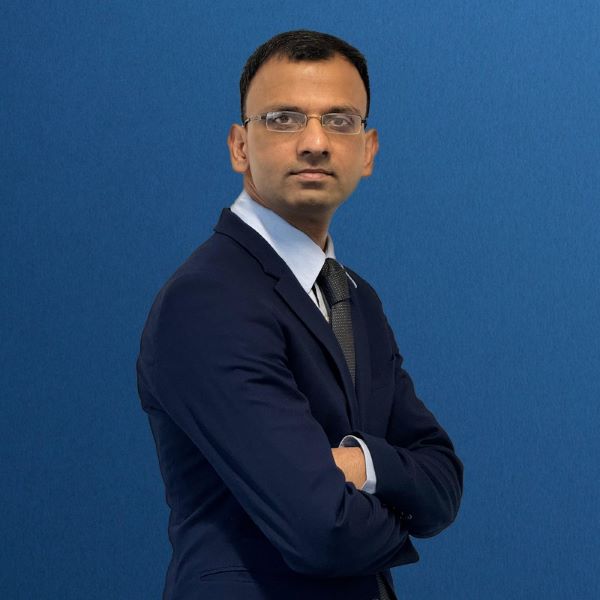
Director
Prof. Dr. Jay Krishna Thakur, the director of EIIET. Since starting his journey as a dedicated teacher, Prof. Thakur has transitioned into the dynamic role of Director at our institute. In addition to his teaching career, he has ventured into the business realm, specialising in Business Consulting, Forecasting, Planning and Analytics, and Financial Planning. This shift highlights not only his adaptability but also his keen understanding of the intersection between academia and practical business applications.
He is an exemplary individual with a diverse and extensive educational background. He holds a Doctorate in Natural Sciences from Martin Luther University, Halle (Saale), Germany, complemented by an MSc in Geo-information Science and Earth Observation for Water Resources and Environmental Management from Twente University, Enschede, the Netherlands. Additionally, he has earned another MSc in Environmental Sciences from Jawaharlal Nehru University, New Delhi, India, a Diploma in Industrial Safety from Annamalai University, India, as well as a Bachelor's in Education and a Bachelor's in Environmental Science from Tribhuvan University, Kathmandu, Nepal. He is a Full Professor of International Business and Computer Science at Euro American Institute, Malta.
His academic journey showcases a commitment to continuous learning and expertise in various fields. With a solid foundation in the natural sciences and specialised knowledge in geo-information science and environmental management, Prof. Thakur brings a multifaceted perspective to the educational landscape.
As a Director, Prof. Thakur plays a pivotal role in shaping the trajectory of the institute. His journey from the classroom to the boardroom equips him to lead strategic initiatives that bridge the gap between education and industry. Driven by a passion for innovation and academic excellence, he steers the institute towards a future where education not only enriches minds but also prepares individuals for the complexities of the professional world.
Prof. Thakur's vision encompasses a holistic approach to education, recognising the importance of blending academic rigour with real-world insights. His leadership ensures that the institute remains at the forefront of educational innovation, fostering an environment where students not only gain knowledge but also develop the skills and perspectives needed to thrive in a rapidly evolving global landscape.
Drawing from his teaching experience, Prof. Thakur instills a student-centric approach in the institute's ethos, emphasising the transformative power of education. Under his guidance, the institute continues to flourish as a hub of learning, research, and business acumen, making a lasting impact on both the academic and professional journeys of its students.
Publication
Book (2011)
1. Thakur, J.K., Singh, S.K., Ramanathan, A.L., Prasad, M. B. K. and Gossel W., Geospatial Techniques for Managing Environmental Resources, Springer Publication, Germany (http://www.springer.com/
Peer reviewed ISI Ranked Journal Articles
- JK Thakur*, K Khanal, K Poudyal (2019) Land cover changes for enhancing water availability in watersheds of Tanahun and Kaski, Nepal, Journal of Water and Climate
- JK Thakur*, K Khanal, K Poudyal (2017) Assessment of Regional Changes for Enhancing Water Availability, Environmental Systems Research
- JK Thakur*, SK Singh, VS Ekanthalu (2017) Integrating remote sensing, geographic information systems and global positioning system techniques with hydrological modeling, Applied Water Science 7 (4), 1595-1608
- JK Thakur*, K Khanal, K Poudyal (2017) LUPWY: land use planner for water yield for environmental change analysis, Modeling Earth Systems and Environment 3 (1), 44
- JK Thakur*, M Neupane, AA Mohanan ( 2017) Water poverty in upper Bagmati River Basin in Nepal, Water Science
- Jay Krishna Thakur*, Sudhir Kumar Singh (2017), Integrating remote sensing, geographic information systems and global positioning system techniques with hydrological modeling, Applied Water Science, pp 1-14
- JK Thakur* (2016) Hydrogeological modeling for improving groundwater monitoring network and strategies, Applied Water Science, 1-18
- Jay Krishna Thakur* (2015) Optimizing Groundwater Monitoring Network using Integrated Statistical and Geostatistical Approaches, Hydrology, 2, 148-175
- Jay Krishna Thakur*, Jasmine Diwakar and Sudhir Kumar Singh (2015) Hydrogeochemical evaluation of groundwater of Bhaktapur Municipality, Nepal, Environmental Earth Sciences (DOI: 10.1007/s12665-015-4514-4)
- Diwakar Paudel, Jay Krishna Thakur, Sudhir Kumar Singh and Srivastava P.K (2015), Soil characterization based on land cover heterogeneity over a tropical landscape: An integrated approach using Earth Observation datasets, Geocarto International Volume 30, Issue 2,
- Subedi, A., J. K. Thakur, et al. (2015). “Participatory conservation and community forest management in Narayani Buffer zone, Chitwan National Park, Nepal.” Bulletin of Environmental and Scientific Research 4(4): 13-21.
- M Neupane, JK Thakur*, A Gautam, A Dhakal, M Pahari (2014) Arsenic aquifer sealing technology in wells: a sustainable mitigation option, Water Air Soil Pollut, 225, 1-15.
- Jay Krishna Thakur*, Prafull Singh, Sudhir Kumar Singh and Bijendra Bhaghel (2013) Geochemical modelling of fluoride concentration in hard rock terrain of Madhya Pradesh, India, Acta Geologica Sinica-English Edition, Volume 87, Issue 5, pages 1421–1433, doi: 10.1111/1755-6724.12139.
- Sudhir Kumar Singh, Prashant K. Srivastava, Manika Gupta, Jay Krishna Thakur, Saumitra Mukherjee (2013), Appraisal of land use/land cover of mangrove forest ecosystem using support vector machine, Volume 71, Issue 5, pp 2245-2255 (DOI: 10.1007/s12665-013-2628-0).
- Ram Avtar*, Pankaj Kumar, C. K. Singh, Netrananda Sahu, R. L. Verma, J. K. Thakur, S. Mukherjee (2013), Hydrogeochemical Assessment of Groundwater Quality of Bundelkhand, India Using Statistical Approach, Water Quality, Exposure and Health, Volume 5, Issue 3, pp 105-115
- P.K. Srivastava, S.K. Singh, J.K. Thakur, M. Gupta, S. Mukherjee (2013) Modelling Impact of Landuse change trajectories on groundwater quality using remote sensing and GIS, Environmental Engineering and Management Journal (12 (12)).
- Diwakar, J., Thakur, J. K.* (2012). Environmental system analysis for river pollution control. Water, Air, & Soil Pollution, Volume 223, Number 6, 3207-3218 (10.1007/s11270-012-1102-z).
- Prafull Singh, Jay Krishna Thakur and U.C. Singh (2012), Morphometric analysis of Morar River Basin, Madhya Pradesh, India Using Remote Sensing and GIS Techniques, Environmental Earth Sciences, Volume 68, Issue 7, pp 1967-1977 (DOI: 10.1007/s12665-012-1884-8).
- Singh, P., Thakur, J.K., Kumar, S., 2012. Delineating groundwater prospect zones in a hard rock terrain, using geospatial tools. Hydrological Sciences Journal, volume 58, issue 1, page 213-223.
- Thakur, J. K.*, P.K., S. et al. (2011). Ecological monitoring of wetlands in semi-arid region of Konya closed Basin, Turkey. Regional Environmental Change, 12(1), 133-144.
- Thakur, J. K.*, Ramanathan, A., et al. (2011). “Arsenic Contamination of Ground Water in Nepal – An Overview.” Journal of Water.